$50M+ RECOVERED FOR CLIENTS



Florida records hundreds of thousands of crashes each year, and the state’s no-fault system adds insurance rules that many drivers do not fully understand until after a wreck. That can create real confusion when it is time to figure out what an auto policy will actually pay. As a law firm specializing in personal injury cases, it should be no surprise that many of the cases we work on involve car accidents in Pinellas. Many of our clients have what is considered a “Full Coverage” auto insurance policy. They are shocked when it does not provide enough to cover the medical bills and/or property damage costs resulting from their accident.
The term “full coverage auto insurance policy” is often used by insurance providers to describe a policy that should protect drivers in most types of incidents. However, this phrase lacks a single legal definition in Florida and often gives people a false sense of security. Many drivers use it to describe a policy that includes PIP, property damage liability, collision, and comprehensive coverage. That still may leave major gaps, especially if the policy does not include bodily injury liability coverage or uninsured/underinsured motorist coverage. The goal of this blog post is to educate more Florida drivers about what full coverage really means and why they may need to invest in a more comprehensive policy.
The “full coverage” auto insurance in Pinellas, which covers your car completely, would be ideal. What exactly does “full coverage” mean? How can this term be misleading when choosing the right vehicle coverage? The term “full coverage” for car insurance does not have a standard definition. It’s important to customize a car insurance policy to suit your individual needs rather than buy a one-size-fits-all policy. Consider how much protection you need for your assets and properties. You may have a different version of full coverage auto insurance than someone else. In Florida, your typical full-coverage car insurance policy includes at least liability, comprehensive, and collision coverage. Comprehensive coverage pays for your car’s repair if it is damaged in a storm, by an animal attack, by a flood, by a fire, or if it is stolen or vandalized. If you get into an accident, collision covers any damage to your vehicle (unlike liability, which only covers damage to the other driver’s vehicle).
What this often leaves out is just as important. Florida generally requires PIP and property damage liability coverage, but bodily injury liability coverage is generally not required for most drivers. That means a driver may believe they have “full coverage” and still learn after a serious crash that there is no bodily injury coverage available to pay for someone else’s medical losses. A policy also may not include uninsured/underinsured motorist coverage unless it was added or not rejected.
That is why it helps to look past the phrase on the declaration page and focus on the policy’s actual terms. A better question is not whether the policy is called full coverage. The better question is whether it includes the kinds of protection that could matter after a serious crash, such as bodily injury liability coverage, uninsured/underinsured motorist coverage, collision and comprehensive coverage, and deductibles you can realistically afford.
Types of coverage, limits, and deductibles affect your premium. It is important to remember this when comparing car insurance rates. Those who choose to carry higher limits of coverage than the state requires will probably have to pay a higher premium than those with the state’s minimum limits. It is normal for the cost of those coverages to be lower if you choose a higher deductible. Florida drivers pay on average $1257 a year or $104 a month for full coverage auto insurance. Here is a breakdown of the premium cost of the site:
You can reduce your insurance costs by comparing policies and asking about driver discounts. Insurance rates also vary significantly based on your driving history. You pay more if you are a young driver or if you have a history of violations and claims than if you were an older driver without tickets or accidents.
The no-fault system in Florida means that your PIP insurance covers your injuries regardless of which driver caused the accident. If you have permanent injuries or if you suffer medical bills or lose income totaling at least $10,000 following an accident, you can still sue the at-fault driver. Your optional bodily injury policy will pay the damages if you are the at-fault driver. Without bodily injury insurance, you will have to pay out of pocket. In this case, you should submit a claim through your PIP policy first. You are covered for 80 percent of all your medical expenses under this plan. The policy of the at-fault driver kicks in if you suffer serious injuries.
Following an auto accident in Florida, the bodily injury coverage of the at-fault driver may pay for the court-ordered settlement as well as the legal fees of the other driver. If a driver has only minimum auto insurance, he or she is responsible for paying these costs.
Florida now follows a modified comparative negligence rule in most negligence cases. That person’s share of fault reduces an injured person’s recovery. But if the injured person is found to be more than 50 percent at fault for their own harm, recovery is barred. In a disputed car accident case, witness statements, vehicle damage, phone records, and crash-scene proof can be much more important than they first appear.
In the event of an accident, PIP is supposed to cover 80 percent of your medical bills and 60 percent of your lost wages, up to $10,000, as mentioned earlier. Disability benefits cover medical, surgical, and funeral expenses as well as loss of income. Since Florida is a “no-fault” state, the insurance company is responsible for up to $10,000 in damages, regardless of fault. Unfortunately, under the current no-fault law, the $10,000 amount set aside doesn’t even begin to cover the cost of many medical bills. Accounting for inflation, the $10,000 threshold introduced in 1979 would be worth $77,000 today.
There is another limit that catches many people off guard. Florida’s PIP statute requires initial services and care within 14 days after the motor vehicle accident. It also limits reimbursement to $2,500 unless an authorized provider determines that the injured person had an emergency medical condition. So even when a policy has the full $10,000 PIP limit, the amount actually available may depend on both timing and diagnosis.
In Florida, many drivers still lack meaningful protection in the event of a serious crash. Nationwide, more than one in seven drivers were uninsured in 2023, and Florida remains a state where compulsory auto coverage generally focuses on PIP and property damage liability rather than third-party bodily injury coverage. That is one reason uninsured and underinsured motorist coverage can be so important after a bad wreck.
The percentage of uninsured drivers in Florida is among the highest in the country. It is important to have “Uninsured/Underinsured Motorist” Coverage, as it is not required to carry Bodily Injury Liability Coverage. As a result of this coverage, if you sustain injuries in a car accident caused by another driver whose insurance is either uninsured or inadequate to cover your medical expenses, you will be protected. If you are not sure whether you have this type of coverage at the moment, call your insurance provider to confirm it’s in place.
Many people do not carry Uninsured/Underinsured Motorist Coverage. The majority of people do not know whether or not they have this type of insurance. A Florida policyholder must formally reject uninsured motorist coverage. As a result, some policyholders reject this type of coverage without fully understanding what it is and what they stand to lose by not having this valuable protection. In the event that you do not elect this type of coverage and you are injured in a car accident with an uninsured driver, you will only be covered for $10,000 in Personal Injury Protection (PIP).
Florida Statute § 627.727 governs uninsured motorist coverage. In general, when a policy includes bodily injury liability coverage, uninsured motorist coverage must be offered, and any rejection or selection of a lower limit must be made on an approved form. That form must state to the applicant that the coverage equals the bodily injury liability limits unless lower limits are requested or the coverage is rejected. It must also use a 12-point bold warning stating that valuable coverage is being declined or reduced.
That is why reviewing the declarations page matters so much. Do not assume “full coverage” includes UM protection. It may, but it may not. The only reliable way to know is to check whether UM was accepted, rejected, stacked, or limited to lower amounts. For many Florida families, that one line on the policy can make a major difference after a crash caused by a driver with no bodily injury coverage or not enough of it.
If you don’t know what kinds of auto insurance coverage you have, contact your provider for more information. It’s not fun to review your policy, but if you’ve been in a car crash, you know how important it is to understand your coverage and have the right amount of coverage.
If you have been injured in a car accident caused by an uninsured driver, here’s what a personal injury lawyer can do for an insured Florida driver:
To better understand how your claim will be handled, an attorney will review and investigate all possible insurance policies available, the parties involved, and all other relevant details. Herman & Wells works with our clients to educate them on the legal system and assess their insurance policies.
While you are the insurance company’s customer, your insurance adjuster is not exactly on your side. An attorney who has handled many Florida car accident cases is your best advantage over an insurance adjuster, to ensure a fair and just settlement. You can depend on our attorneys to ensure you get all the money you deserve for the injuries, property damages, and other losses you suffered.
During the evidence-gathering phase of a personal injury case, our lawyers understand the rules that need to be followed. Our clients’ claims are maximized if we know which evidence is most valuable to insurance companies and which is not. As lawyers, we are familiar with how to preserve evidence and meet deadlines for settling a case.
While their advertising may be focused on having your back in any bad situation, the reality is that your insurance provider is a company that needs to stay in business. This means that when someone is filing a claim that could be worth six figures or more, the attitude is going to change. We strongly advise not viewing the insurance adjuster assigned to review your claim as your friend. Anything you say when talking to an adjuster can and will be used against you. Even if you are careful when interacting with the adjuster, insurance companies have dedicated teams (that include their own lawyers) who are focused on doing whatever it takes to save the company money. If you have a valid car accident claim that has been underpaid or denied, you should speak with an experienced personal injury attorney if you haven’t already. Our team of attorneys has extensive experience going up against these insurance companies in court. This, unfortunately, is often required to receive the compensation one really needs following a serious car accident in Florida.
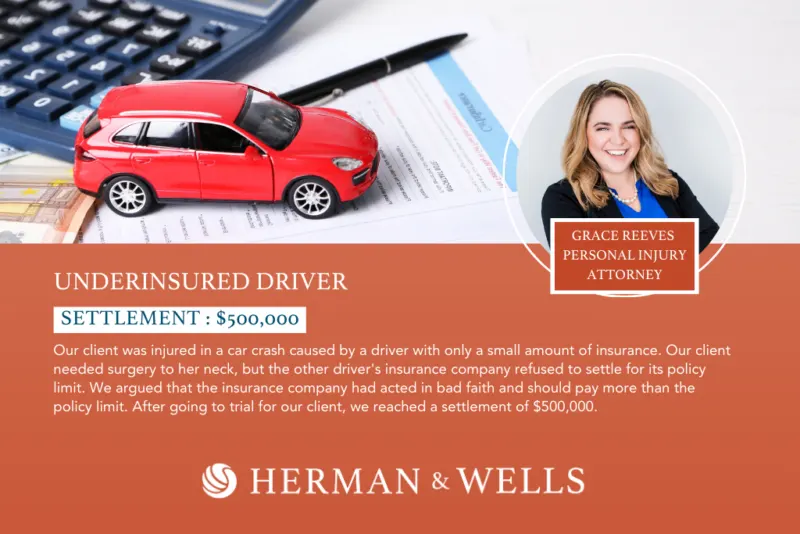
After a crash, the insurance process can be frustrating. You may be trying to find out which policy applies, whether the other driver carried enough coverage, or why your own “full coverage” policy is not paying what you expected. We help injured Florida drivers review available insurance, deal with adjusters, and understand what options may still be available after a serious wreck.
Herman & Wells has recovered more than $50 million for clients. Our recent case results as of the time of this writing include a $2.5 million rear-end collision verdict and a $1.275 million settlement for a St. Petersburg T-bone collision victim. Those results do not guarantee what will happen in another case, but they show the level of claims our firm has handled.
You should not have to chase your lawyer for updates while dealing with medical care, vehicle damage, and insurance delays. Our 30-Day Communication Promise is designed to prevent clients from being left in silence for extended periods.
If your “full coverage” policy does not go as far as you expected, we can review your insurance options and help you decide how to move forward.
The majority of people do not think about totaled vehicles, major medical bills, and coverage gaps until it is too late. But too many Florida drivers are either uninsured or carrying only the minimum protection required to stay on the road. So, if you believe you are “fully protected” in the event of an accident, it is worth taking a second look at your policy now, before a crash forces the issue. Planning and securing adequate insurance before an accident may make a major difference in the resources available later.
Purchasing full-coverage auto insurance is wise because you will most likely incur more damage than the absolute minimum coverage will cover.
If you have recently been in an accident and think your policy may not go as far as you expected, Herman & Wells offers a free case evaluation. Our attorneys focus on communication and on helping clients understand what coverage may be available and what options may exist after a serious crash.